Wednesday, July 6, 2016

10 Ways To Cut $500 On Monthly Bills


There are dozens of ways you can easily stop wasting money on discretionary expenses. But, what about those monthly bills that consume the bulk of your budget?
Here's some good news: There are plenty of ways you can cut these costs. By using the following savings strategies, you can lower your monthly bills by $500 or more. But keep in mind the actual savings you'll see will vary depending on which cost-cutting moves you choose to make. Still, these examples prove it's possible to cut hundreds of dollars off your monthly expenses.

1. Save Big on Groceries

Grocery spending can take a big bite out of your monthly budget. A family of four spends up to $1,284 a month on food at home, according to May 2016 data from the U.S. Department of Agriculture. One of the best ways to save money on groceries is to stock up on items that are non-perishable or can be frozen when they are on sale, rather than buying just what you need for the week.
"When shoppers buy only their weekly needs, they are forced to pay full price for 50 percent to 80 percent of what goes in their cart," said Teri Gault, founder, and CEO of TheGroceryGame.com.
Once you have a stockpile, you can plan weekly meals around what you have and perishable items that are on sale at the supermarket. Gault said that TheGroceryGame.com members reported average savings of $523 a month for a family of four by stockpiling sale items and using coupons.

2. Lower Credit Card Payments With a Balance Transfer

If you carry a balance on a credit card with a high-interest rate, you could dramatically decrease the amount you pay each month by taking advantage of a 0 percent balance transfer offer. Depending on your current credit card balance and current interest rate, you could easily save more than $500.
But when you compare balance transfer credit card offers, pay close attention to balance transfer fees that might eliminate some of the savings you'll get by moving your balance to a lower-rate card.

3. Cut the Cost of Wireless Service

If you're not locked into a contract with a wireless service provider, you might be able to lower your monthly bill by switching to a smaller carrier that offers more competitive pricing than major carriers.
But if you don't want to switch to a smaller carrier that might have a limited coverage area, you still might be able to lower your monthly bill with a major carrier. Check your statement to see if you're actually using all of the data for which you're paying. When my husband and I did this, we cut our wireless service bill by $30 a month by switching to a plan with a lower data allotment.

4. Eliminate Your Landline

Growing numbers of households are ditching their landline telephone service and relying only on wireless service, according to a CDC National Health Interview Survey released in 2015. If you rely primarily on your smartphone or cellphone to make calls, what's holding you back from joining the 47 percent of wireless-only American households?
Consumers spent an average of $353 a year on residential phone service in 2014, according to the U.S. Department of Labor's Consumer Expenditure Survey. So, you'd save about $30 a month by dropping your landline.

5. Cut the Cable Cord — or at Least Trim It

The cost of cable TV isn't getting any cheaper. In September 2015, the Leichtman Research Group released a report that found the mean reported monthly spending on pay-TV is $99.10, which is nearly a 40 percent increase since 2010. Cutting your cable chord can quickly save you close to $100 a month.
But if you're not ready to give up cable TV entirely, you could lower your bill by forgoing pricey premium channels and opting for the most basic package. Then, you can get your movie fix with inexpensive streaming options, such as Amazon, Hulu or Netflix.
Read; 6 Basic Bills You Should Always Negotiate

6. Re-Shop Your Auto Insurance

Loyalty doesn't always pay when it comes to auto insurance. The J.D. Power 2016 U.S. Insurance Shopping Study found that consumers who shopped for better auto insurance rates and switched insurers saved an average of $356 on their annual premium.
Based on that figure, you could save about $30 a month by switching to a lower-rate auto insurance policy. You can get quotes and compare offers from several insurers at TheZebra.com, InsuranceQuotes.com and, CarInsurance.com.

7. Lower Your Homeowners Insurance Premium

Raising your homeowners insurance deductible from $500 to $1,000 could shave 25 percent off your premium, according to the Insurance Information Institute. So if you pay $1,000 annually, that translates to savings of $250 — about $20 a month.

8. Slash Your Electric Bill

You can lower your heating and cooling costs by using a programmable thermostat to automatically adjust the temperature in your house when you're away from home. In fact, proper use of a programmable thermostat can save about $180 a year — or $15 a month — in energy costs, according to the Environmental Protection Agency's Energy Star program.
You can reduce your bill even more by identifying and unplugging "energy vampires," devices such as cable TV boxes and DVD players that use electricity even when turned off. They can account for up to 20 percent of your electric bill, according to Duke Energy, the nation's largest electric power holding company. Since the federal Energy Information Administration found the average monthly electric bill to be $114 in 2014, you could save about $23 a month by unplugging all of your energy vampires.

9. Shrink Your Monthly Mortgage Payment by Refinancing

If your home's value has risen since you bought it and interest rates have dropped since you locked in your mortgage rate, you might be able to lower your monthly mortgage payment by refinancing.
According to a 2016 Black Knight Financial Services report, 3.3 million homeowners could save at least $200 a month by refinancing their mortgages, and nearly 1 million could save $400 or more each month.
Keep Reading: How to Pay Off Your Mortgage in 10 Years

10. Stop Overpaying Uncle Sam

If you got a big tax refund this year — the average was about $3,000 — that means you're letting Uncle Sam withhold too much from your paycheck each month. Sure, it's nice to get a big check every spring, but you'll have more spending money each month if you adjust your tax withholding so that you're not overpaying the IRS.

File a new W-4 form with your employer to claim more allowances because the more you claim, the less tax is withheld. If you received the average refund of roughly $3,000, you should get an extra $250 in your paycheck each month by adjusting your withholding.

Source: aol.com

Sunday, June 19, 2016

Only A Dad

Only a Dad
 gif
Edgar A. Guest (1916)
clr gif

Only a dad with a tired face,
Coming home from the daily race,
Bringing little of gold or fame
To show how well he has played the game;
But glad in his heart that his own rejoice
To see him come and to hear his voice.

Only a dad with a brood of four,
One of ten million men or more
Plodding along in the daily strife,
Bearing the whips and the scorns of life,
With never a whimper of pain or hate,
For the sake of those who at home await.

Only a dad, neither rich nor proud,
Merely one of the surging crowd,
Toiling, striving from day to day,
Facing whatever may come his way,
Silent whenever the harsh condemn,
And bearing it all for the love of them.

Only a dad but he gives his all,
To smooth the way for his children small,
Doing with courage stern and grim
The deeds that his father did for him.
This is the line that for him I pen:
Only a dad, but the best of men.

Tuesday, May 17, 2016

Standing Alone

It was alone I took my stand strengthened by an unseen hand, 
Alone I started in the fight, left the darkness for the light.
Alone I face the foe today, The Lord of hosts is still my stay. 
I know I am so very weak so I must my Father seek.
It is alone that I must pray, the spirit helps me day by day, 
And through its help I get to see something in the word for me.
In times when I alone must be, The Lord stands by and strengthens me. 
When great decisions I must make, He from the throne doth undertake.
Its not what others do or say that really hinders progress in the way; 
But fear that fills my heart each day lest I should ever leave this way.
Many a time like Christ, and Paul, we stand alone, forsook by all; 
But this will help us to depend Upon Him as a faithful friend.
Fragments
Broken fragments, bits of clay strangely scattered in the way. 
Touch them gently, walk with care, Christ remembers spikenard there.
Shattered pitchers dot the field; here the conqueror's trumpet peaked. 
Christ remembers light held high where the broken fragments lie.
Near the fountain crushed and bruised lie the vessels Christ has used. 
Here let tenderness abound; Softly tread on Holy ground.
Though we sat not where “twas given," Though we fought not where “twas striven," God forbid that we despise Fragments of their sacrifice.
(composed for a worn out worker)
(Elma Wiebe)

Wednesday, April 6, 2016

Merle Haggard


Breaking News: Country music legend Merle Haggard, who was known for hits like "Okie From Muskogee" and "Mama Tried," died on his 79th birthday.

Source: FoxNews.com 

Merle Haggard in concert 2013.jpg
Merle Haggard in concert in Athens, Georgia, in 2013

Merle Ronald Haggard (April 6, 1937 – April 6, 2016) was an American country music songwriter, singer, guitarist,fiddler, and instrumentalist. Along with Buck Owens, Haggard and his band the Strangers helped create the Bakersfield sound, which is characterized by the twang of Fender Telecaster and the unique mix with the traditional country steel guitar sound, new vocal harmony styles in which the words are minimal, and a rough edge not heard on the more polished Nashville sound recordings of the same era.
By the 1970's, Haggard was aligned with the growing outlaw country movement, and he continued to release successful albums through the 1990's and into the 2000's. In 1994, he was inducted into the Country Music Hall of Fame. In 1997, he was inducted into the Oklahoma Music Hall of Fame.
Early Life: 
Haggard's parents, Flossie Mae (Harp) and James Francis Haggard, moved to California from their home inChecotah, Oklahoma, during the Great Depression, after their barn burned in 1934. They settled with their children, Lowell and Lillian, in an apartment in Bakersfield, while James started working for the Santa Fe Railroad. A woman who owned a boxcar, which was placed in Oildale, a nearby town north of Bakersfield, asked Haggard's father about the possibility of converting it into a house. He remodeled the boxcar, and soon after moved in, also purchasing the lot, where Merle Ronald Haggard was born on April 6, 1937.[The property was eventually expanded by building a bathroom, a second bedroom, a kitchen and a breakfast nook in the adjacent lot.
His father died of a brain hemorrhage in 1945, an event that deeply affected Haggard during his childhood, and the rest of his life. To support the family, his mother worked as a bookkeeper. His brother, Lowell, gave Haggard his used guitar as a gift when he was 12 years old. Haggard learned to play alone, with the records he had at home, influenced by Bob Wills, Lefty Frizzell and Hank Williams. As his mother was absent due to work, Haggard became progressively rebellious. His mother sent him for a weekend to a juvenile detention center to change his attitude, which worsened.
Haggard committed a number of minor offences, such as thefts and writing bad checks. He was sent to a juvenile detention center for shoplifting in 1950. When he was 14, Haggard ran away to Texas with his friend Bob Teague. He rode freight trains and hitchhiked throughout the state. When he returned the same year, he and his friend were arrested for robbery. Haggard and Teague were released when the real robbers were found. Haggard was later sent to the juvenile detention center, from which he and his friend escaped again to Modesto, California. He worked a series of laborer jobs, including driving a potato truck, being a short order cook, a hay pitcher, and an oil well shooter. His debut performance was with Teague in a Modesto bar named "Fun Center," being paid US$5, with free beer. He returned to Bakersfield in 1951, and was again arrested for truancy and petty larceny and sent to a juvenile detention center. After another escape, he was sent to the Preston School of Industry, a high-security installation. He was released 15 months later, but was sent back after beating a local boy during a burglary attempt. After his release, Haggard and Teague saw Lefty Frizzell in concert. After hearing Haggard sing along to his songs backstage, Frizzell refused to sing unless Haggard would be allowed to sing first. He sang songs that were well received by the audience. Due to the positive reception, Haggard decided to pursue a career in music. While working as a farmhand or in oil fields, he played in nightclubs. He eventually landed a spot on the local television show Chuck Wagon, in 1956.[8]
Married and plagued by financial issues, he was arrested in 1957 shortly after he tried to rob a Bakersfield roadhouse. He was sent to Bakersfield Jail, and was transferred after an escape attempt to San Quentin Prison, on February 21, 1958. While in prison, Haggard discovered that his wife was expecting a child from another man, which pressed him psychologically. He was fired from a series of prison jobs, and planned to escape along with another inmate nicknamed "Rabbit". Haggard was convinced not to escape by fellow inmates. Haggard started to run a gambling and brewing racket with his cellmate. After he was caught drunk, he was sent for a week to solitary confinement where he encountered Caryl Chessman, an author and death row inmate. Meanwhile, "Rabbit" had successfully escaped, only to shoot a police officer and return to San Quentin for execution. Chessman's predicament, along with the execution of "Rabbit," inspired Haggard to turn his life around. Haggard soon earned a high school equivalency diploma and kept a steady job in the prison's textile plant, while also playing for the prison's country music band, attributing a 1958 performance by Johnny Cash at the prison as his main inspiration to join it. He was released from San Quentin on parole in 1960.
According to Rolling Stone, "In 1972, then-California governor Ronald Reagan expunged Haggard's criminal record, granting him a full pardon."
Early Career:
Haggard depicted on a publicity portrait for Tally Records (1961, age 24).
Upon his release, Haggard started digging ditches and wiring houses for his brother. Soon he was performing again, and later began recording with Tally Records. The Bakersfield Sound was developing in the area as a reaction against the over-produced honky tonkof the Nashville Sound. Haggard's first song was "Skid Row". In 1962, Haggard wound up performing at a Wynn Stewart show in Las Vegas and heard Wynn's "Sing a Sad Song". He asked for permission to record it, and the resulting single was a national hit in 1964. The following year he had his first national top ten record with "(My Friends Are Gonna Be) Strangers", written by Liz Anderson(mother of country singer Lynn Anderson) and his career was off and running. In his 1981 autobiography Merle Haggard: Sing Me Back Home, Haggard recalls having been talked into visiting Anderson—a woman he didn't know—at her house to hear her sing some songs she had written. "If there was anything I didn't wanna do, it was sit around some danged woman's house and listen to her cute little songs. But I went anyway. She was a pleasant enough lady, pretty, with a nice smile, but I was all set to be bored to death, even more so when she got out a whole bunch of songs and went over to an old pump organ...There they were. My God, one hit right after another. There must have been four or five number one songs there..." In 1966, Haggard recorded his first number-one song "I'm a Lonesome Fugitive", also written by Liz Anderson, which became his first #1 single. When Anderson played the song for Haggard, she was unaware of his prison stretch. "I guess I didn't realize how much the experience at San Quentin did to him, 'cause he never talked about it all that much," Bonnie Owens, Haggard's backup singer and then-wife, is quoted by music journalist Daniel Cooper in the liner notes to the 1994 retrospective Down Every Road. "I could tell he was in a dark mood...and I said, 'Is everything okay?' And he said, 'I'm really scared.' And I said, 'Why?' And he said, 'Cause I'm afraid someday I'm gonna be out there...and there's gonna be some convict...some prisoner that was in there the same time I was in, stand up—and they're gonna be about the third row down—and say, 'What do you think you're doing, 45200?'" Cooper notes that the news had little effect on Haggard's career: "It's unclear when or where Merle first acknowledged to the public that his prison songs were rooted in personal history, for to his credit, he doesn't seem to have made some big splash announcement. In a May 1967 profile in Music City News, his prison record is never mentioned. But in July 1968, in the very same publication, it's spoken of as if it were common knowledge."
The 1966 album Branded Man kicked off an incredible artistic run for Haggard; in 2013 Haggard biographer David Cantwell states, "The immediate successors toI'm a Lonesome FugitiveBranded Man in 1967 and, in '68, Sing Me Back Home and The Legend of Bonnie and Clyde—were among the finest albums of their respective years." Haggard's new recordings largely centered around Roy Nichols's Telecaster, Ralph Mooney's steel guitar, and the harmony vocals provided by Bonnie Owens. At the time of Haggard's first top-ten hit "(My Friends Are Gonna Be) Strangers" in 1965, Owens was actually the better known performer, a fixture on the Bakersfield club scene who had recorded and appeared on television. Bonnie, who had been married to Buck Owens, won the new Academy of Country Music's first ever award for Female Vocalist after her 1965 debut album, Don't Take Advantage of Me, hit the top five on the country albums chart. However, there were no more hit singles, and although Owens recorded six solo albums on Capitol between 1965 and 1970, she became mainly known for her background harmonies on Haggard hits like "Sing Me Back Home" and "Branded Man." Producer Ken Nelson took a hands-off approach to producing Haggard. In the episode ofAmerican Masters dedicated to him, Haggard remembers: "The producer I had at that time, Ken Nelson, was an exception to the rule. He called me 'Mr. Haggard' and I was a little twenty-four, twenty-five year old punk from Oildale...He gave me complete responsibility. I think if he'd jumped in and said, 'Oh, you can't do that,' it would've destroyed me." In the documentary series Lost Highway, Nelson recalls, "When I first started recording Merle, I became so enamored with his singing that I would forget what else was going on, and I suddenly realized, 'Wait a minute, there's musicians here you've got to worry about!' But his songs—he was a great writer." Towards the end of the decade, Haggard went on a songwriting tear, composing several #1 hits as "Mama Tried," "The Legend of Bonnie and Clyde," "Hungry Eyes," and "Sing Me Back Home." Daniel Cooper calls "Sing Me Back Home," "a ballad that works on so many different levels of the soul it defies one's every attempt to analyze it." In a 1977 interview in Billboard with Bob Eubanks, Haggard reflected, "Even though the crime was brutal and the guy was an incorrigible criminal, it's a feeling you never forget when you see someone you know make that last walk. They bring him through the yard, and there's a guard in front and a guard behind—that's how you know a death prisoner. They brought Rabbit out...taking him to see the Father,...prior to his execution. That was a strong picture that was left in my mind." In 1968, Haggard's first tribute LP Same Train, Different Time: A Tribute to Jimmie Rodgers, was released to acclaim.
Number One Hits: 
  1. "I'm a Lonesome Fugitive" (1966)
  2. "Branded Man" (1967)
  3. "Sing Me Back Home" (1968)
  4. "The Legend of Bonnie and Clyde" (1968)
  5. "Mama Tried" (1968)
  6. "Hungry Eyes" (1969)
  7. "Workin' Man Blues" (1969)
  8. "Okie from Muskogee" (1969)
  9. "The Fightin' Side of Me" (1970)
  10. "Daddy Frank" (1971)
  11. "Carolyn" (1971)
  12. "Grandma Harp" (1972)
  13. "It's Not Love (But It's Not Bad)" (1972)
  14. "I Wonder If They Ever Think of Me" (1972)
  15. "Everybody's Had the Blues" (1973)
  16. "If We Make It Through December" (1973)
  17. "Things Aren't Funny Anymore" (1974)
  18. "Old Man from the Mountain" (1974)
  19. "Kentucky Gambler" (1974)
  20. "Always Wanting You" (1975)
  21. "Movin' On" (1975)
  22. "It's All in the Movies" (1975)
  23. "The Roots of My Raising" (1975)
  24. "Cherokee Maiden" (1976)
  25. "Bar Room Buddies" (with Clint Eastwood) (1980)
  26. "I Think I'll Just Stay Here and Drink" (1980)
  27. "My Favorite Memory" (1981)
  28. "Big City" (1981)
  29. "Yesterday's Wine" (with George Jones) (1982)
  30. "Going Where the Lonely Go" (1982)
  31. "You Take Me for Granted" (1982)
  32. "Pancho and Lefty" (with Willie Nelson) (1983)
  33. "That's the Way Love Goes" (1983)
  34. "Someday When Things Are Good" (1984)
  35. "Let's Chase Each Other Around the Room" (1984)
  36. "A Place to Fall Apart" (with Janie Frickie) (1984)
  37. "Natural High" (1985)
  38. "Twinkle, Twinkle Lucky Star" (1987)

Awards: 


Source: wikipedia.com


Monday, March 28, 2016

Downtown Memphis, Tennessee / Memphis Public Promenade


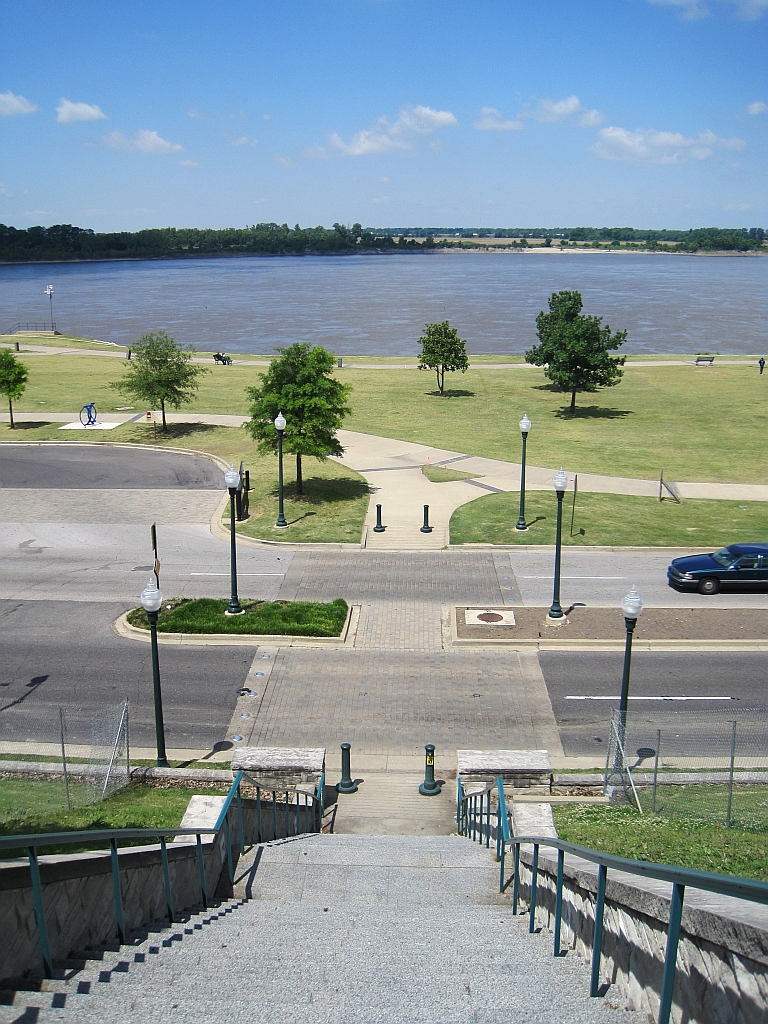
It is too often forgotten that the founders of Memphis gave the community an easement for public use to a large tract of land known as the Public Promenade. The area includes what is now the whole waterfront between Beale and the A.W. Willis Bridge, including the west side of Front Street. The Promenade has been obscured in lawsuits over use and ownership for decades, including a 1955 Tennessee Supreme Court definition of air rights when parking garages were to be built on the river front. Today, The Riverfront Development Commission is under contract by the City of Memphis to oversee and protect the City’s interest for part of the City’s riverfront, but not all of the original public easement of the Promenade.


Downtown Memphis, Tennessee is the central business district of Memphis, Tennessee and is located along the Mississippi River between Interstate 40 to the north, Interstate 55 to the south and I-240 to the east, where it abuts Midtown Memphis.
Confederate Park Front St.
It is home to the Memphis Redbirds, the AAA affiliate of the St. Louis Cardinals, and the Memphis Grizzlies NBA team.


History:

Downtown is the oldest part of the city and includes the riverfront and the bluffs overlooking the Mississippi river. The founders of Memphis dedicated the riverfront to the public "now and forever" as long as the public use continued. The land overlooking the riverfront was originally planned to become a "public promenade" to be called Mississippi Row. The upper riverfront became the site of the river landing where steamboats were loaded with cotton and other goods in the 19th and early 20th centuries. Between 1844 and 1886 the river landing was paved with limestone and granite cobblestones brought in from the upper Midwest. This created what is today the largest intact Mississippi River landing still in existence, and is listed on the National Register of Historic Places.[1] The explosion of the steamboat Sultana in 1865 near Memphis was one of the worst marine disasters in history.
 The Memphis river landing (1906)
There are several historic residences downtown, particularly in the Victorian Village neighborhood. Other historic homes include the Hunt-Phelan House (1830), the Magevney House (ca. 1835) and the Burkle Estate (1849). The Burkle home and the Hunt Phelan House (533 Beale Street) were reputed to have been part of the underground railroad by which escaped slaves made their way to freedom prior to the Civil War.
Memphis Queen
Downtown Airport: 
In 1959, the Memphis Downtown Airport was opened on Mud Island, which at that time was called City Island. The one-runway airport could be reached by a pontoon-boat ferry and was used mostly by businessmen and shoppers. The Downtown Airport was closed in 1970. It was replaced in the 1990's by the new urbanist Harbor Town development.
Buildings
Jefferson Davis Park
The Downtown Memphis skyline contains the tallest buildings in the city. The tallest building in Memphis, 100 North Main, is located at the heart of downtown along Main Street at Adams Ave and rises to 430 ft (131m). Some notable and/or historic downtown buildings are:
Downtown Memphis consists of 8.4 million square feet (780,000 square meters) of office space, around 1 million square feet (93,000 square meters) of retail space, 3,456 hotel rooms, and 13,400 housing units.
Tom Lee Park
The administrative core of Memphis and Shelby County is also located in Downtown Memphis. These include the Memphis City Hall, and the Federal Building, located on North Main Street, in the Civic Center Plaza (corner of Main Street and Washington). Downtown Memphis also contains the Memphis branch of the Federal Reserve Bank of St. Louis.
Downtown Core
Beale Street Landing
Downtown Core is the heart of the central business district and includes the majority of office space, retail, entertainment and dining spaces. It is a popular regional destination for entertainment, dining, and tourism and includes attractions such as Beale Street, FedExForum, AutoZone Park, and the Peabody Hotel.
Harahan Bridge from Martyrs Park
Districts And Neighborhoods
Memphis Riverfront:


Downtown Memphis is located on the banks of the Mississippi River. The Memphis Riverfront stretches from the Meeman-Shelby Forest State Park in the north, to T. O. Fuller State Park in the south.
The River Walk is a park system along the Mississippi River that connects the Mississippi River Greenbelt Park in the north, to Tom Lee Park in the south.
Mississippi River Greenbelt Park
Points of interest along the riverfront