Your fences need to be horse-high, pig-tight and bull-strong.
Keep skunks and bankers and lawyers at a distance.
Life is simpler when you plow around the stump.
A bumble bee is considerably faster than a John Deere tractor.
Words that soak into your ears are whispered...not yelled.
Don't interfere with somethin' that ain't botherin' you none.
Meanness don't jes' happen overnight.
Do not corner something that you know is meaner than you.
It don't take a very big person to carry a grudge.
You cannot unsay a cruel word.
Every path has a few puddles.
When you wallow with pigs, expect to get dirty.
The best sermons are lived, not preached.
Live a good, honorable life. Then when you get older and think back, you'll enjoy it a second time.
Timing has a lot to do with the outcome of a rain dance.
If you find yourself in a hole, the first thing to do is stop diggin'.
Don't judge folks by their relatives.
Sometimes you get, and sometimes you get got.
The biggest troublemaker you'll probably ever have to deal with, watches you from the mirror every mornin'.
Always drink upstream from the herd.
Good judgment comes from experience, and a lotta that comes from bad judgment.
Lettin' the cat outta the bag is a whole lot easier than puttin' it back in.
Forgive your enemies. It messes up their heads.
If you get to thinkin' you're a person of some influence, try orderin' somebody else's dog around.
Live simply. Love generously. Care deeply. Speak kindly. Leave the rest to God.
Most of the stuff people worry about ain't never gonna happen anyway.
Remember that silence is sometimes the best answer.
Author Unknown
Tuesday, March 27, 2012

Wednesday, March 14, 2012
Kids Growing Up
My Mom used to defrost hamburger on the counter AND I used to eat a bite raw sometimes, too. Our school sandwiches were wrapped in wax paper, in a brown paper bag, not in icepack coolers, but I can't remember anybody getting e.coli.
Almost all of us would have rather gone swimming in the lake instead of a pristine pool (talk about boring), no beach closures then.
The term cell phone would have conjured up a phone in a jail cell, and a pager was the school PA system.
We all took gym, not PE...and risked permanent injury with a pair of high top Ked's (only worn in gym) instead of having cross-training athletic shoes with air cushion soles and built-in light reflectors. I can't recall any injuries but they must have happened, because they tell us how much safer we are now.
Flunking gym was not an option...Even for the stupid kids! I guess PE must be much harder than gym.
Speaking of school, we all said prayers and sang the National Anthem, and staying in detention after school caught all sorts of negative attention. We must have had horribly damaged psyches.
What an archaic health system we had then. Remember school nurses? Ours wore a hat and everything, and she could even give you an aspirin for a headache or fever.
I thought that I was supposed to accomplish something before I was allowed to be proud of myself. I just can't recall how bored we were without computers, Play Station, Nintendo, X-box or 279 digital TV cable stations.
Oh yeah...and where was the Benadryl and sterilization kit when I got that bee sting? I could have been killed!
We played 'king of the hill' on piles of gravel left on vacant construction sites, and when we got hurt, Mom pulled out the 48-cent bottle of Mercurochrome (kids liked it better because it didn't sting like iodine did) and then we got our butt spanked!
Now it's a trip to the emergency room, followed by a 10-day dose of a $49 bottle of antibiotics, and then Mom calls the attorney to sue the contractor for leaving a horribly vicious pile of gravel where it was such a threat.
We didn't act up at the neighbor's house either, because if we did, we got our butt spanked there, and then we got our butt spanked again when we got home. I recall Donny Reynolds from next door coming over and doing his tricks on the front stoop, just before he fell off. Little did his Mom know that she could have owned our house. Instead, she picked him up and swatted him for being such a goof. It was a neighborhood run amuck.
Author Unknown
Almost all of us would have rather gone swimming in the lake instead of a pristine pool (talk about boring), no beach closures then.
The term cell phone would have conjured up a phone in a jail cell, and a pager was the school PA system.
We all took gym, not PE...and risked permanent injury with a pair of high top Ked's (only worn in gym) instead of having cross-training athletic shoes with air cushion soles and built-in light reflectors. I can't recall any injuries but they must have happened, because they tell us how much safer we are now.
Flunking gym was not an option...Even for the stupid kids! I guess PE must be much harder than gym.
Speaking of school, we all said prayers and sang the National Anthem, and staying in detention after school caught all sorts of negative attention. We must have had horribly damaged psyches.
What an archaic health system we had then. Remember school nurses? Ours wore a hat and everything, and she could even give you an aspirin for a headache or fever.
I thought that I was supposed to accomplish something before I was allowed to be proud of myself. I just can't recall how bored we were without computers, Play Station, Nintendo, X-box or 279 digital TV cable stations.
Oh yeah...and where was the Benadryl and sterilization kit when I got that bee sting? I could have been killed!
We played 'king of the hill' on piles of gravel left on vacant construction sites, and when we got hurt, Mom pulled out the 48-cent bottle of Mercurochrome (kids liked it better because it didn't sting like iodine did) and then we got our butt spanked!
Now it's a trip to the emergency room, followed by a 10-day dose of a $49 bottle of antibiotics, and then Mom calls the attorney to sue the contractor for leaving a horribly vicious pile of gravel where it was such a threat.
We didn't act up at the neighbor's house either, because if we did, we got our butt spanked there, and then we got our butt spanked again when we got home. I recall Donny Reynolds from next door coming over and doing his tricks on the front stoop, just before he fell off. Little did his Mom know that she could have owned our house. Instead, she picked him up and swatted him for being such a goof. It was a neighborhood run amuck.
Author Unknown
Tuesday, March 6, 2012
Shampoo Joke
I NEVER KNEW THIS!!! This INVOLVES THE SHAMPOO WHEN IT RUNS DOWN YOUR BODY WHEN YOU USE IT In The SHOWER!!!!
WARNING TO ALL!!!
YOU NEED TO READ THIS. DON'T DELETE IT BEFORE READING!
I HAVE JUST RECEIVED THIS WARNING!
Shampoo Warning
I don't know WHY I didn't figure this out sooner!
I use shampoo in the shower!
When I wash my hair, the shampoo runs down my whole body, and there it is, Printed very clearly on the shampoo label, this warning:
"FOR EXTRA VOLUME AND BODY."
No wonder I have been gaining weight!
Well! I have gotten rid of that shampoo and I am now using Dawn dish detergent instead.
Its label reads:
"DISSOLVES FAT THAT IS OTHERWISE DIFFICULT TO REMOVE."
Problem solved!
If I don't answer the phone I'll be in the shower!
Ha! Ha! I just wanted to share this one with you.
Source: Internet
WARNING TO ALL!!!
YOU NEED TO READ THIS. DON'T DELETE IT BEFORE READING!
I HAVE JUST RECEIVED THIS WARNING!
Shampoo Warning
I don't know WHY I didn't figure this out sooner!
I use shampoo in the shower!
When I wash my hair, the shampoo runs down my whole body, and there it is, Printed very clearly on the shampoo label, this warning:
"FOR EXTRA VOLUME AND BODY."
No wonder I have been gaining weight!
Well! I have gotten rid of that shampoo and I am now using Dawn dish detergent instead.
Its label reads:
"DISSOLVES FAT THAT IS OTHERWISE DIFFICULT TO REMOVE."
Problem solved!
If I don't answer the phone I'll be in the shower!
Ha! Ha! I just wanted to share this one with you.
Source: Internet
Friday, February 24, 2012
Butterbeans ~ Little Jimmy Dickens
BUTTER BEANS - Little Jimmy Dickens
[4/4 Key of C](Tune of "Just A Closer Walk With Thee)
[C] Just a bowl of but-ter [G] beans
Pass the [G7] corn-bread if you [C] please
[C7] I don't want no col-lard [F] gre- [D7] ens
All I [C] want is a [G] bowl of but-ter [C] beans.
[C] Just a piece of coun-try [G] ham
Pass the [G7] but-ter and the [C] jam
[C7] Pass the bis-cuits if you [F] ple- [D7] ase
And some [C] more o' them [G] good ol' but-ter [C] beans.
[C] Red eye gravy is all [G] right
Tur-nip [G7] sand-wich a de- [C] light
[C7] But my child-ren all still [F] scr- [D7] eam
For [C] an-oth-er [G] bowl of but-ter [C] beans.
[ Lyrics from: http://www.lyricsmode.com/lyrics/l/little_jimmy_dickens/butterbeans.html ]
[C] Some folks think that corn-pones [G] best
Some likes [G7] grits more than the [C] rest
[C7] But if I was a man of [F] me- [D7] ans
I'd just [C] wa-ant them [G] good ol' but-ter [C] beans.
[C] See that La-dy ov-er [G] there
With the [G7] curl-ers in her [C] hair
[C7] She's not preg-nant as she [F] se- [D7] ems
She's just [C] full o' them [G] good ol' but-ter [C] beans.
[C] When they lay my bones to [G] rest
Place no [G7] ros-es upon my [C] chest
[C7] Plant no bloom-ing ev-er- [F] gre- [D7] ens
All I [C] want is' a [G] bowl of but-ter [C] beans.
[C] Just a bowl of butter [G] beans
Pass the [G7] corn-bread if you [C] please
[C7] I don't no col-lard [F] gre-[D7] ens
All I [C] want is' a [G] bowl of but-ter [C] beans.
Source: Internet
[4/4 Key of C](Tune of "Just A Closer Walk With Thee)
[C] Just a bowl of but-ter [G] beans
Pass the [G7] corn-bread if you [C] please
[C7] I don't want no col-lard [F] gre- [D7] ens
All I [C] want is a [G] bowl of but-ter [C] beans.
[C] Just a piece of coun-try [G] ham
Pass the [G7] but-ter and the [C] jam
[C7] Pass the bis-cuits if you [F] ple- [D7] ase
And some [C] more o' them [G] good ol' but-ter [C] beans.
[C] Red eye gravy is all [G] right
Tur-nip [G7] sand-wich a de- [C] light
[C7] But my child-ren all still [F] scr- [D7] eam
For [C] an-oth-er [G] bowl of but-ter [C] beans.
[ Lyrics from: http://www.lyricsmode.com/lyrics/l/little_jimmy_dickens/butterbeans.html ]
[C] Some folks think that corn-pones [G] best
Some likes [G7] grits more than the [C] rest
[C7] But if I was a man of [F] me- [D7] ans
I'd just [C] wa-ant them [G] good ol' but-ter [C] beans.
[C] See that La-dy ov-er [G] there
With the [G7] curl-ers in her [C] hair
[C7] She's not preg-nant as she [F] se- [D7] ems
She's just [C] full o' them [G] good ol' but-ter [C] beans.
[C] When they lay my bones to [G] rest
Place no [G7] ros-es upon my [C] chest
[C7] Plant no bloom-ing ev-er- [F] gre- [D7] ens
All I [C] want is' a [G] bowl of but-ter [C] beans.
[C] Just a bowl of butter [G] beans
Pass the [G7] corn-bread if you [C] please
[C7] I don't no col-lard [F] gre-[D7] ens
All I [C] want is' a [G] bowl of but-ter [C] beans.
Source: Internet
Thursday, February 16, 2012
How To Identify A Sears Home
Click Here to go to the website.
Listed below is a link for pictures of Sears homes. Click Here
Sears Homes 1908-1940
Sears Home Catalog
Listed below is a link for pictures of Sears homes. Click Here
Sears Homes 1908-1940
Sears Home Catalog
Sears Catalog Home

Advertisement for Modern Home No. 115
Sears Catalog Homes (sold as Sears Modern Homes) were ready-to-assemble kit houses sold through mail order by Sears, Roebuck and Company, an American retailer. Over 70,000 of these were sold in North America between 1908 and 1940. Shipped via railroad boxcars, these kits included all the materials needed to build a house. Many were assembled by the new homeowner and friends, relatives, and neighbors, in a fashion similar to the traditional barn-raisings of farming families.
As an add-on, Sears offered the latest technology available to house buyers in the early part of the twentieth century. Central heating, indoor plumbing, and electricity were all new developments in house design that "Modern Homes" incorporated, although not all of the houses were designed with these conveniences. Central heating, for example, not only improved the livability of houses with little insulation but also improved fire safety, a worry in an era when open flames threatened houses and even entire cities, as in the Great Chicago Fire (1871).
As demand decreased, Sears expanded the product line to feature houses that varied in expense to meet the budgets of various buyers. Sears began offering financing plans in 1916. However, the company experienced steadily rising payment defaults throughout the Great Depression, resulting in increasing strain for the catalog house program. More than 370 designs of Sears Homes were offered during the program's 32-year history. The mortgage portion of the program was discontinued in 1934 after Sears was forced to liquidate $11 million in defaulted debt. Sears closed their Modern Homes department in 1940. A few years later, all sales records were destroyed during a corporate house cleaning. The only way to find these houses today is literally one by one.
Today, some communities across the United States feature clusters of the houses as unofficial historical sites. Elgin, Illinois (a Chicago suburb) has the largest known collection of Sears Homes, with more than 200 Sears Homes (and few kit homes from other companies as well). A culture of Sears Modern Home seekers has emerged in recent years, as individual buildings have been identified.
Sears mail order history
In 1886, the United States contained only 38 states. Many people lived in rural areas and typically farmed. Richard Sears had been a railroad station agent in Minnesota. He moved to Chicago, Illinois, where he met Alvah C. Roebuck who joined him in the business. In 1893, the corporate name became Sears, Roebuck and Co.
Richard Sears knew that farmers often brought their crops to town where they could be sold and shipped, and then bought supplies, often at very high prices, from local general stores. He and Roebuck offered a solution via mail-order catalogs. Thanks to volume buying, railroads, post offices, and later rural free delivery and parcel post, they offered a welcome alternative to the high-priced rural stores.
By 1894, the Sears catalog had grown to 322 pages, featuring sewing machines, bicycles, sporting goods and a host of other new items. By the following year, dolls, icebox refrigerators, cook-stoves and groceries had been added to the catalog. Sears, Roebuck and Co. soon developed a reputation for both quality products and customer satisfaction. Its wide range of products was very popular, especially in areas far flung from big cities and large department stores. People had learned to trust Sears for other products bought through mail-order, and thus, sight unseen. This laid important groundwork for supplying a house, possibly the largest single investment a typical family would ever make.
Sears Modern Homes 1908–1940
In 1906, Frank W. Kushel, a Sears manager, was given responsibility for the catalog company's unwieldy, non-profitable building materials department. Sales were down, and there was excess inventory languishing in warehouses. He is credited with suggesting to Richard Sears that the company assemble kits of all the parts needed and sell entire houses through mail order.
In 1908, Sears issued its first specialty catalog for houses, Book of Modern Homes and Building Plans, featuring 22 styles ranging in price from US$650–$2,500 ($15,388–$59,187 in 2008 dollars). Sears bought a lumber mill in Southern Illinois and arranged for production of kits from which homes could be assembled. The first mail order was filled in 1909.
Shipped by railroad boxcar, and then usually trucked to a home site, the average Sears Modern Home kit had 25 tons of materials, with over 30,000 parts, and came with such utilities as electric and gaslight fixtures in early models. Plumbing and electrical fixtures and heating systems were not included in the kit, but could be purchased separately. Local building requirements sometimes dictated that those items be done professionally and varied to meet requirements of each area of the country. For example, foundation depth requirements varied by climate and terrain.
The Aladdin Company of Bay City, Michigan, was the first to offer kit homes (in 1906), and Sears joined the fray in 1908. However, Sears mail-order catalogs were already in millions of homes, enabling large numbers of potential homeowners simply to open a catalog, select and visualize their new home, dream, save, and then purchase it. Sears offered financing, assembly instructions, and guarantees. Early mortgage loans were typically for 5–15 years at 6%–7% interest.
The ability to mass-produce the materials used in Sears homes lessened manufacturing costs, which lowered purchase costs for customers. Precut and fitted materials reduced construction time by up to 40%.
Sears's use of "balloon style" framing systems did not require a team of skilled carpenters, as did previous methods. Balloon frames were built faster and generally only required one carpenter. This system used precut timber of mostly standard sizes (2"x4" and 2"x8") for framing. Precut timber, fitted pieces, and the convenience of having everything, including the nails, shipped by railroad directly to the customer added to the popularity of this framing style.
A later feature was the use of drywall instead of plaster and lath wall-building techniques which required skilled carpenters. Drywall offered the advantages of low price, ease of installation, and added fire protection. It was also a good fit for the square design of Sears homes.
During the Modern Homes program, large quantities of asphalt shingles became available. The alternative roofing materials available included tin and wood. Tin was noisy during storms, looked unattractive, and required a skilled roofer, while wood was highly flammable. Asphalt shingles, however, were cheap to manufacture and ship, and easy and inexpensive to install.
Rather, as a retailer, the company was much more focused on offering what customers would purchase. The Modern Homes features of central heating, indoor plumbing, and electrical wiring were the first steps for many families to modern HVAC systems, kitchens, and bathrooms.
As sales grew, Sears expanded production, shipping and sales offices to regional sites across the US, hitting its peak in 1929, just before the Great Depression. By then, the least expensive model was under US$1,000; the highest priced was under US$4,400 ($12,590 and $55,390 in 2008 dollars respectively).
Sears Modern Home sales stalled during the Depression years, but sales of modest homes were still strong. Later, changes in housing codes and the complexity of modern construction made kit homes less desirable, and sales were cancelled.
Heritage
Sears Catalog Homes proved to be both affordable and of substantial construction. One of Sears's, and indeed the nation's, biggest selling models was the common bungalow. This compact, affordable house began as a vacation-style home in the 1880s but grew into a major housing type in cities and suburbs in the years before World War I. Sears homes have become increasingly popular among history enthusiasts because of their sturdy structure, unusual building and architectural design concepts.
Not all buyers were individuals or small volume developers. In 1918, Standard Oil Company purchased a large group of the Sears houses for its mineworkers in Carlinville, Illinois, at a cost of approximately US$1 million. Today 152 of the original 156 homes still exist, and this is one of the largest known contiguous collections of Sears Catalog Homes in the United States. There are nine styles of houses in a nine block area which represents Standard Addition in Carlinville. Styles are the Langston Model, Madelia Model, Warrenton Model, Whitehall Model, Roseberry Model, Lebanon Model, and the Gladstone Model. And notably, the Carlin Model was actually named after Carlinville, by Sears, Roebuck & Co. for supposedly having the largest order on record for the houses. There are more Sears homes dotted throughout Carlinville. It took nine months to complete the building of Standard Addition which was completed in 1919.
Sears Homes in significant numbers can be found in Virginia, West Virginia, North Carolina and a few have been found as far south as Florida and as far west as California. There are at least two Sears Homes in the old mill town of Newton Falls, New York, and the entire Town Site neighborhood in Bucksport, Maine, consists of Sears Homes in the Belfast model. While their locations today are not known due to variations in designs both during initial construction and subsequent renovations or modifications, most of those sold by Sears, Roebuck have probably survived.
Clusters can be found all across the United States and are proudly featured by communities such as Arlington, Virginia, and the surrounding area with 100, Hopewell, Virginia, with 42 in the Crescent Hills neighborhood, and Downers Grove, Illinois, with 27. Aurora, Illinois, has 136 documented Sears catalog homes giving it one of the largest concentrations in the country; the largest, at 152, is located in Carlinville, Illinois. Houston, Texas' historic Norhill neighborhood is known to have many of these homes.
And, not all of them became private residences. At Greenlawn Cemetery, near the Hampton Roads waterfront in the Newport News, Virginia, area, the cemetery office building is a 1936 Sears Catalog Home.
Links
Sears Modern Home
Sears kit homes in Arlington County, Virginia
"The Whole Kit and Caboodle", a Washington Post article about Sears Catalog mail-order homes in the Washington, DC area
"Made to Order: Many American Dreams Came Out of the Sears Catalog, Including Do-It-Yourself Houses" a Los Angeles Times article
"Yesterday's kit houses are today's sought-after properties" a South Coast Today (Connecticut) article
Source: Internet
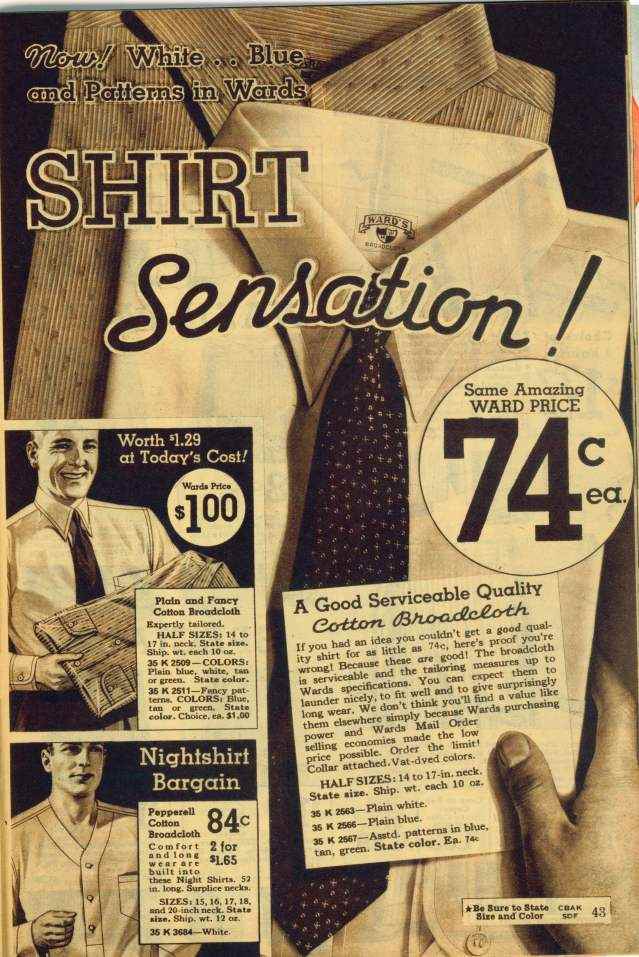
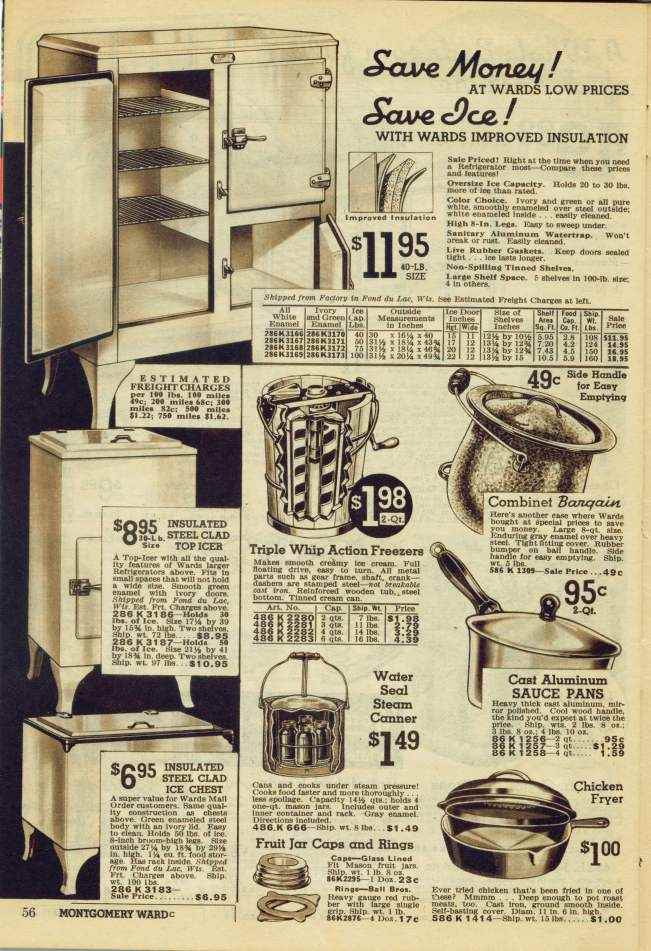
Montgomery Ward 1934 Catalog
Thought you'd enjoy this one, love the prices and notice at the very bottom line, if you are married and order $100. worth, you have to have your HUSBAND sign also.


Source: Internet




Source: Internet
Subscribe to:
Posts (Atom)